


Georgia Tech alumni are fulfilling the Institute’s mission to help those in need.
 On the official seal of the Georgia Institute of Technology, three words are prominently featured: “Progress and Service.” Tech is widely known for embodying the first half of that motto. While the second half of the motto, “… and Service,” might not get as much attention, it has always been central to Georgia Tech’s identity. The impetus on service is stressed in Tech’s current mission statement: “We will be leaders in improving the human condition in Georgia, the United States and around the globe.” The Institute’s alumni play a huge role in that ambitious effort. They volunteer as teachers and mentors. They rebuild after natural disasters. They take part in TEAM Buzz community service projects. They raise funds for medical research and the Roll Call annual fund. We put a call out to our alumni, asking for their stories of exceptional service projects. And, as we expected, our inbox was flooded with suggestions. Here, we highlight some of those stories. Share your own in the comments below.
Trekking for Kids | Finding the Next Chess Phenom | Giving Liberians Shoulders to Stand On | Bringing Education to Nepal’s Children | Amputees Find Confidence Through Adventure | Out of Sadness, Hope—and Donuts | Therapy on Horseback | Finding Meaning in the Routine | The Reluctant Rebuilder | Building Homes With the Gray Ghosts | Homes for the Homeless | Alumnus Launches Effort to Benefit Veterans | Have Truck, Will Help | Networks Spearhead Volunteer Projects
Trekking for Kids
Over dinner at a Thai restaurant in Atlanta’s Virginia Highland neighborhood in early 2005, Jose Montero, IE 95, and some friends were discussing a planned hiking excursion to Peru’s Inca Trail. While Montero was excited for the trip, something had been nagging at him.
The group all worked at multinational corporations and spent much of their time in the developing world—Montero worked for The Coca-Cola Company at the time—and often went on such adventures. Often while touring around other countries, he felt guilty for enjoying the physical beauty while the local people lived in extreme poverty.
“I said, ‘We’re going to have a great time, but we’re going to go and nothing’s going to change,’” Montero told his friends. “And I said, ‘What if we do something?’”
Montero went home and thought about the idea. He wanted to help the people who most needed support. “The answer was right under my eyes,” he says.
Montero’s father was an orphan of the Spanish civil war and had suffered through extreme hardships before finally immigrating to the United States. Montero’s mother is a Cuban refugee.
“It was always in my life—the hardship my father endured,” Montero said of his father’s past. “We’re a very humble family. We did not grow up with an abundant means. We grew up in Atlanta living the immigrant story.”
Montero found an orphanage for blind children in Cusco, Peru, and began raising money. At the same time, he filed with the IRS to create a nonprofit, and Trekking for Kids was born.
Instead of simply raising money for the children, Montero and his partners in the endeavor wanted to give the orphanage high-end infrastructure. “We want to give these orphanages a boost that’s sustainable,” he said.
They raised $16,500. The group then spent four days hiking the trail in May 2005 and visited Machu Picchu. Then they traveled to Cusco, where their funding had been used to procure Braille typewriters, toys, sports equipment and food for the 100 children living at El Hogar de Niños Ciegos orphanage.
It was an unbelievable start to the organization, Montero said, but he wanted to do even more. The next year, a group of 40 took part in a hike on the Inca Trail, and they raised $50,000.
Now, seven years after the initial hike, Trekking for Kids has hosted 16 expeditions on five continents and has raised nearly $600,000. Montero just brought on an executive director to help manage the organization. Its leadership also has a strong Georgia Tech contingent: Annie Anton, ICS 90, MS ICS 92, PhD CS 97, chair of Tech’s School of Interactive Computing, is its corporate secretary; Raul Pino, EE 89, MS EE 90, is its chief information officer and head of social media; and Joaquin Davila, MS ME 68, began serving as the “elder statesman” after recently retiring from Coca-Cola.
Most of the group’s leaders are volunteers, including Montero, its chairman.
Two years ago, the Trekking for Kids excursion to the Mount Everest base camp in Nepal was featured in National Geographic’s top 50 trips of a lifetime. The group had so many people sign up that they had to add a second trip.
They’re also expanding into new areas. Last year they hosted their first college trek, an alternative spring break for students from the University of Louisville. Montero said he’d love to have more Ramblin’ Wrecks—alumni and students—come on trips. The expeditions are for amateur hikers who need only to be “somewhat physically fit,” he said.
Trekking for Kids now is exploring other potential alliances as Montero builds the organization into “the brand name for purpose-driven adventure.”
The big draw is that travelers see some of the most stunning places in the world, and they also see firsthand how they’re making a difference. By the time the trekkers arrive at the orphanage, the funds they’ve raised have already been put to use. Typically, those who go on the trip are able to put the finishing touches on the project.
“That goes a long way with our donors, because they see what their money has gone to,” Montero said.
Service was always important to Montero. While at Tech he was a member of ODK and, as president of ANAK, worked to establish the group’s honor code. “I’ve been very blessed,” he said. “I have a lot to be thankful for, so I wanted to find a way to give back.”
Out of the many unforgettable experiences that have come since Montero started Trekking for Kids, the most memorable was bringing his father along on trips and having him serve as the organization’s honorary chairman until he passed away in 2007.
“It was very emotional to see him with the kids,” Montero said. “He loved it. My last conversation with him, he talked about how we had to keep Trekking for Kids going. It was very special.”
Finding the Next Chess Phenom … in Inner-City Washington, D.C.
After earning an MBA from Harvard, Anthony Priest, EE 88, MS IE 90, launched into a promising career in business. But, concerned about the state of education, Priest dropped out and embarked on a new career: as a high school math and science teacher at an inner-city Washington, D.C., high school. Last year, to overcome the challenge of engaging students in the subjects, Priest pulled out his ace in the hole: chess.
The school’s new chess club quickly took off, with students eager to sign up. Priest, who also recently started a nonprofit to support the city’s high school robotics clubs, took his team of chess rookies to the 2011 National High School Chess Championships in Minneapolis, Minn. Here, he recounts the trip.
Our five students from McKinley Technology High School were among the more than 1,300 students from across the nation who had come to the Twin Cities to compete.
At noon on Friday, the opening ceremonies set the pieces in motion. Four of the McKinley students competed in the unranked division; one had played in enough prior tournaments to have earned a rating and competed in a ranked grouping. Having never competed at this level, we expected a case of first-round jitters, but the team won two, lost two and had one draw. This was promising.
The second round was truly amazing, as all five of the McKinley students won their pairings. Saturday morning, we sauntered to the arena to find we were on the leader board in fifth place. The team continued to roll in round three, going a combined 4-1. These early wins added up and vaulted the team into second place. However, as a player wins they move up the rankings and play other students who have also been winning. That led to fourth round results of four losses and a draw. The team slid back to fifth. The dreams of a rookie national championship began to fade into the reality of facing such stiff, seasoned competition.
The final day we were in ninth with two rounds to go. After the first round, the team had repeated its 2-3 record from the night before, dropping into 11th. One round to go.
The team was upbeat, hoping to repeat its earlier 5-0 showing, so everyone could go home on a high note. The bell rang, pieces began to fly, and after the dust settled, the results were 1-2-2, dropping us to a respectable 13th.
There were 151 students in the unrated division, and our four students finished 42nd, 71st, 85th and 94th. Our ranked student finished 48th out of 215. It was an impressive showing for a fantastic group of kids.
Giving Liberians Shoulders to Stand On
A few years ago, John Etherton, CS 05, MS CS 07, was working on his master’s degree and doing his best to avoid getting “a real job” when he noticed a posting on
the Georgia Tech website about the work of Michael Best, an associate professor of international affairs who was studying the effects of computers and the internet in developing countries.
“That sounded exactly like the kind of not-real-job job I was looking for, so I met Dr. Best and signed up for his class,” Etherton said. “The idea of using computers to help people, not just to make U.S. corporations richer, really appealed to me. Plus the idea of getting to travel to exotic places to work sounded great.”
Etherton was selected to travel to Liberia to work on a pilot project to develop a multi-user cellphone. During his six weeks in the country, Etherton saw a place sorely in need of technical skills (he was the only person in the entire country with a master’s degree in computer science), and so he knew he could make a real impact. “Plus, the idea of being in a place where you needed a [four-wheel-drive vehicle] because the road could be washed out by the next rainy season greatly appealed to my boyish need for adventure.”
After graduating, Etherton signed up to work as project manager on another of Best’s projects, a collaboration with Liberia’s Truth and Reconciliation Commission, which lasted until 2009.
But Etherton still wasn’t ready to leave, so he enlisted a colleague in starting up iLab Liberia, a nonprofit computer lab that’s tasked with closing the country’s digital divide. The program often collaborates with Georgia Tech faculty, and last summer Allan Martel, MS DM 12, interned with iLab as an instructor.
The endeavor hasn’t been without its challenges: iLab has struggled to find qualified employees because the civil war brought education to a standstill in Liberia, and much of Etherton’s time goes to fundraising. (Their annual internet bill is $90,000.)
“It’s hard to talk donors into spending that much on just the internet,” he said. “Since there’s no power plant in Liberia, our electricity comes from diesel generators at our office. This is also super expensive.”
His hope is that the consistent access provided by iLab will allow Liberians to learn more about the internet and develop computer skills. Eventually, he wants it to be a place where entrepreneurs can build software and systems that will help the country.
Etherton returned to the United States in 2010 but continues to manage much of iLab’s operation. He also works as a freelance programmer, often for software projects in the developing world.
Service is important to him because he understands how much of his resources and skills is the result of other peoples’ hard work.
“This became really clear to me when living in a place that is starting from scratch,” Etherton said. “I was able to be a computer scientist because someone 100 years ago realized you could make electricity by spinning magnets and wires, then someone else built a vacuum tube, then someone else created a way to store data digitally, then someone else built an operating system and so forth. So I’m just standing on the shoulders of giants. And while I don’t think I’m a giant, I’d like to be the shoulders that someone else can stand on.”
Bringing Education to Nepal’s Children
Steven Lustig, MS ME 95, MBA 09, received his bachelor’s degree at MIT, and was reading his undergrad alma mater’s alumni magazine in 2005 when he came upon an article about the Nepalese Children’s Education Fund, which was founded by fellow MIT students.
The group was working to bring education to the many Nepalese children who had no means to obtain it. NCEF provides children with tuition, textbooks and supplies, relying on volunteers in Nepal to meet with the children and their parents and to monitor their progress in school.

Nepalese students study with materials provided by the Nepalese Children’s Education Fund.
Lustig made a donation to NCEF, then decided to get more involved, first serving as the fund’s secretary and now as president.
Lustig, the manufacturing manager for Coca-Cola’s “Freestyle” touchscreen drink dispensers, said his Tech MBA prepared him well for the challenges that have come with running NCEF.
“We learned about the importance of culture in organizations,” he said. “The cultural differences—between a corporation and a nonprofit, as well as between countries like the U.S. and Nepal—mean that it is important to adapt to the organization and the situation and come up with creative ways to solve problems.”
In 2011, Lustig traveled to Nepal to meet some of the families helped by NCEF. He took the children to an amusement park in Kathmandu and visited two schools in the rural district of Chitwan. “It was an amazing experience,” he said. “It really helped me see the impact of our efforts.”
Amputees Find Confidence Through Adventure
Kristin Carnahan had been working as an engineer for six years when she decided she wanted a career that allowed her to help people directly. Georgia Tech’s orthotics and prosthetics program was the perfect fit.
Alumni Denise Larkins, Richard Welling Jr. and Kristin Carnahan have fun with campers at an adventure camp for amputee children.
While working on her master’s at the Institute, Carnahan met an amputee who’d volunteered at a camp in North Carolina that allowed amputee children to take part in adventure activities. Carnahan, MS PO 08, signed up as a volunteer at Adventure Amputee Camp in 2007 and has been involved ever since, now serving on its board of directors.
Camp activities include a ropes course, zip lines, water skiing, white water rafting, scuba diving and horseback riding.
“I have been inspired year after year by seeing the campers take on challenges that they clearly did not think would be possible to achieve,” Carnahan said. “The ropes course challenges each camper not only physically in terms of navigating the course with less than four intact limbs, but the mental challenge of overcoming a fear of heights is huge as well.
“I’ve seen a camper with no hands climb the 50-foot alpine tower, conquering a feat that many able-bodied adults would shy away from,” Carnahan said. “I see many kids arrive very shy and reserved, only to leave with a new level of confidence and joy that comes from being fully accepted and making new friends.”
Two other Tech alumni volunteer at the camp: Richard Welling Jr., ME 95, MS PO 05, and Denise Larkins, Psych 07, MS PO 09. Larkins volunteered this summer for the first time after moving back to Atlanta to work at Children’s Healthcare of Atlanta earlier in 2012.
“Seeing these kids take on challenges really makes me put my own fears in perspective,” Larkins said. “While the camp is ultimately for the kids, I think the counselors and volunteers benefit just as much, if not more.”
Out of Sadness, Hope—and Donuts
On July 13, 2007, Jeff Brooks, ME 84, and Melissa Webb Brooks, IM 84, found out that their youngest daughter, Taylor, had a desmoplastic small round cell tumor.
Over the following months, the family learned that research into childhood cancers wasn’t nearly as far along as research into adult cancers. But Taylor was undaunted. She organized a Thanksgiving party for fellow patients at Scottish Rite in Atlanta, raising thousands of dollars for the event. She then led a fundraiser, which ultimately resulted in a new Aflac Cancer Center being built, complete with computers, TVs, DVD players and Playstations for the children there. Taylor cut the ribbon at the grand opening.
Five days later, on April 1, 2008, she lost her fight with cancer.
Jeff and Melissa formed the Taylor Brooks Foundation to keep their daughter’s memory alive. They have raised funds to sponsor a fellowship at Children’s Healthcare of Atlanta to study pediatric cancer.
The foundation also provides gift bags to patients on holidays, hosts an annual holiday party in December (complete with gifts for all of the children), delivers Krispy Kreme donuts every Sunday and takes patients on an annual outing to the Gwinnett Gladiators hockey team’s teddy bear toss game, where teddy bears are thrown onto the ice after the Gladiators’ first goal. It was one of their daughter’s favorite events.
Therapy on Horseback
Service has always been important to Candy Houston, IE 98, MS IE 99. She recalled her parents constantly volunteering when she was a child. And then, at Georgia Tech, Houston joined Tau Beta Sigma, the music honor and service sorority, and took part in projects like helping Girl Scouts earn music badges.
But service took on new meaning in 2009 when Houston was laid off from work and friends pitched in to help her find a new job.
“It underscored the importance of service for me,” she said. “Service can take a lot of different forms. It can be helping the family down the street who’s dealing with a serious illness or helping a former co-worker who’s in job search mode.”
To give back—and to get out of the house while her search continued—Houston looked for a volunteer opportunity. She read about Parkwood Farms Therapy Center, a nonprofit in Snellville, Ga., that provides therapeutic riding and other equine activities for special needs children and adults.
Houston grew up around horses and cofounded the Georgia Tech Equestrian Society, an Alumni Association Affinity Group. She began helping out with therapeutic riding sessions every Tuesday and Thursday afternoon. Gradually, she took on more projects, like writing grant applications and helping organize fundraisers. She has since started a new job, but her involvement with Parkwood continues, now as a board member and helping with weekly riding sessions.
“My favorite part of the volunteering experience at Parkwood Farms is easily the kids’ smiles,” Houston said. “When these individuals with various special needs participate in therapeutic riding and other equine-assisted activities, it doesn’t feel to them like they are receiving therapy—they are doing something fun.”
Finding Meaning in the Routine
After having surgery at the Fairfield, Ohio, Mercy Hospital in 2000, Charles “Bud” Aydlett, IE 58, felt the need to give something back in thanks for the great care that he received.
Aydlett hoped to volunteer in the hospital’s cancer section, but he was assigned to the section that handles patients who go through knee and hip replacement surgery. His work isn’t flashy—assembling information packets for new patients, organizing items for nurses to use in patients’ rooms—but it is meaningful.
“This may seem routine for a Tech engineering grad, but I have found that my real mission is to help assure patient comfort and care, so I spend time with [patients] when possible to converse and share faith if desired,” Aydlett said. “Believe me, I come away from a lot of these visits more blessed than I give blessings.”
The Reluctant Rebuilder
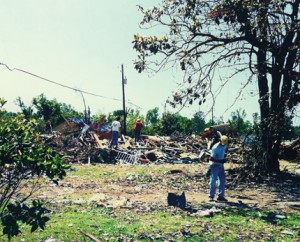 “Right after the tornadoes hit, I didn’t do anything,” admitted Marc Corsini, IM 80.
Corsini lives in Birmingham, Ala., where, on April 27, 2011, strong tornadoes damaged or destroyed thousands of homes and businesses and killed 239 people. A friend’s challenge shook Corsini from his inertia. “She said, ‘You know so many people. You can make a difference.’”
So he planned to spend a day with a group from his church clearing debris from areas struck by the storm. Corsini sent an email to some 200 contacts, and 10 volunteers showed up with tools and a backhoe.
“When we visited the first location, I was taken back at the devastation,” Corsini said. “Houses were destroyed everywhere. We saw police arrest a looter. And there was plenty of debris to clear—everywhere.”
By day’s end, the group decided they wanted to work the following week as well. They toiled at the seemingly insurmountable task on 12 Fridays over a 15-week period. Mostly the team—which became known as “TGIF”—helped people who didn’t have insurance to clear downed trees and other debris from their property. Corsini’s task was finding volunteers and coordinating transportation to the day’s project.
Earlier this year, the task of clearing debris was complete. Rather than disband, the group changed its focus to rebuilding. Over another series of 12 Fridays, TGIF partnered with Habitat for Humanity to help a family rebuild their home.
Corsini said he was doing work he’d never dreamed he would do and helping out people he didn’t know, but it became one of the most fulfilling things he’d ever experienced.
“I came to love the work, the volunteers and the people we helped,” he said. “It is so rewarding.”
Building Homes With the Gray Ghosts
They call themselves the Gray Ghosts. Over the past two decades, this loose-knit group of Atlanta retirees—including several Georgia Tech alumni—has bonded together at Habitat for Humanity build sites, by their count working on more than 500 houses.
George Chapman, CE 72, has contributed to about 85 Habitat houses (he never kept exact count) over 15 years of volunteering and now serves as a skilled supervisor for the organization’s Atlanta branch.
Having worked as a land surveyor, Chapman transitioned into an increased role with Habitat after his retirement four years ago. On the recent Southern Crescent Habitat build south of Atlanta, he worked as the unpaid project manager to develop five townhouse units. The homes recently were dedicated after eight weeks of construction.
Other Tech alumni who are part of the Gray Ghosts include Frank Jenkins, Cls 81, and Charlie Thompson, IM 62.
Homes for the Homeless
Looking for Frederick A. Massey, Sr.? Check up on the roof.
When he isn’t running Massey Automotive in Marietta, Ga., the 1976 industrial management grad spends much of his time helping with construction projects for churches and for the homeless. He’s a longtime volunteer with Habitat for Humanity, and he recently led a team from five churches that built a day facility for MUST Ministries in Cobb County.
After finishing the MUST project, Massey was named president of Family Promise of Cobb County, which helps families facing homelessness.
He also has stayed involved with Georgia Tech, helping to lead the funding and building of the Pi Kappa Phi’s fraternity house on campus.
Alumnus Launches Effort to Benefit Veterans
After retiring from a career that included serving as president of three airline companies, Lewis Jordan, AE 67, decided he wanted to focus his time on giving back. And when he and his wife, Joni, thought about giving back, they decided nobody deserved support more than America’s military veterans.
The couple created GratitudeAmerica in late 2011. The organization connects community volunteers with service providers, seeking to expand the network of those who offer services and care to veterans.
There are tens of thousands of groups that provide services to veterans, Jordan said, and it can be daunting for veterans or their loved ones to sort through so many organizations.
The Jordans started the organization in Fernandina Beach, Amelia Island and Nassau County in Florida and plan to expand it across the country. GratitudeAmerica has received support from NBC’s Tom Brokaw, retired U.S. Sen. Bob Dole and military leaders.
Both Lewis and Joni’s fathers served in World War II, and the couple said they’re grateful for the opportunity to give back.
Have Truck, Will Help
Ian Lehn, ME 09, didn’t live in the region directly affected by Hurricane Sandy, and he didn’t work in disaster relief. But he did have a cousin with a “big truck,” and that was reason enough to help. Lehn and his cousin filled the truck with supplies and headed northeast, as reported at MSNBC.
Networks Spearhead Volunteer Projects
The Alumni Association’s regional Alumni Networks gather for TEAM Buzz community service days, hold scholarship fundraisers and contribute to their areas in countless other ways. Here are just a handful of examples of the good work they’re doing. To find an opportunity to volunteer with fellow alumni, visit gtalumni.org/volunteer.
- The Western North Carolina Network worked on a Habitat for Humanity house last year. Members showed up on a Saturday raise the roof trusses on a house in Asheville, N.C.
- The Columbus, Ga., Network hosts a fall festival for a local girls’ home each year as part of TEAM Buzz Day. The Anne Elizabeth Shepherd Home provides residential care for severely emotionally and behaviorally disturbed females aged 7-18. The festival includes games, crafts and a cookout.
- On Aug. 25, the Suncoast, Fla., Network had a TEAM Buzz beach cleanup at Cypress Point Park in Tampa. Twenty members, including 10 young alumni, attended. After a quick breakfast, they took up their cleaning supplies and began collecting trash—75 pounds total. They handed out a prize for the strangest piece of trash collected. The winning item? A pair of ancient swim trunks with plants growing through them.
- The Fort Lauderdale Network assisted with the beautification of Camp Elmore after it reopened in June after being devastated by Hurricane Wilma in 2005. The 117-acre plot of land was the Boy Scouts’ only campground in Broward or Palm Beach counties. Network members replanted trees, moved boulders and helped with landscaping.
- Eight Coweta-Fayette, Ga., Network members worked as judges for the RESA Regional Science and Engineering Fair in their area. The network also gave a $50 cash award at the Regional Science Fair as the “Rambin Reck” award for most original science project, as chosen by the Tech judges.
- A dozen Tech alumni, family and friends joined forces to collect, box and load donations for the 15th annual Mayflower Marathon Food Drive in the Hampton Roads, Va., area. The Hampton Roads Network also participated in the Clean the Bay cleanup event in June, helping to clear more than 68 tons of debris from the shores of the Chesapeake Bay.
- Members of the Richmond, Va., Network collected more than 1,500 pieces of trash—including tires, TVs, phonebooks and pillows—from storm drains in Richmond this fall. They also labeled 12 storm covers with “No Dumping” placards.
- The Central Florida network recently sorted supplies at a warehouse for Harvest Time International, which distributes food, household goods and medical supplies to send to nonprofit organizations in the United States.


 Twitter