


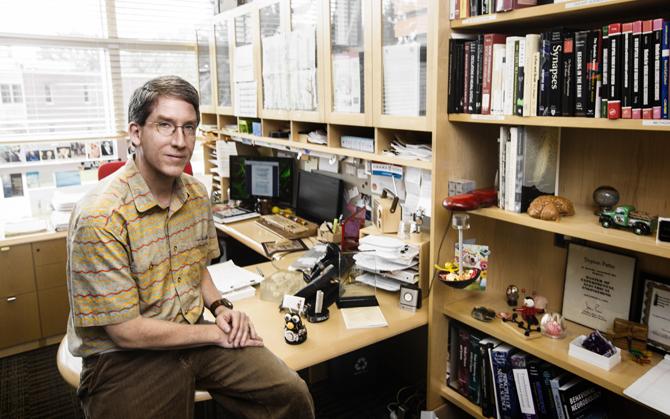
In Steve Potter’s office, two motifs quickly emerge: robots and brains. It’s a fitting pairing. Potter is an associate professor of biomedical engineering and the director of the Institute’s Laboratory for NeuroEngineering, and his research focuses on the intersection of neuroscience and engineering. Among his most noteworthy projects is the Hybrot, a culture of rat neurons connected to electrodes that can be stimulated to control a robot. Potter also has been recognized as a leader in education. This year he received the University System of Georgia’s top honor, the Regents’ Award for Excellence in Teaching. Potter gave the Alumni Magazine a tour of his office in the Whitaker Building.
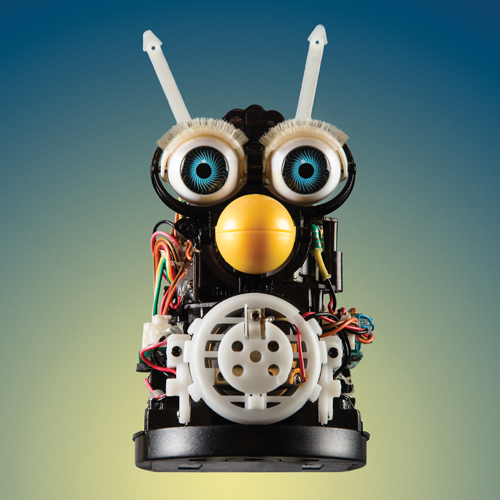
This is a de-furred Furby. I was dead curious what was inside. They don’t have an off switch, so when I was cutting off the skin, it was saying, “Oh, this is fun!” Why is it so effective at convincing kids that it has a soul? Well, it looks like an animal. What happens if you add more and more features? Eventually it becomes closer to a person. I’m a mechanist, and so I think that humans just have a lot more mechanisms than a Furby does.
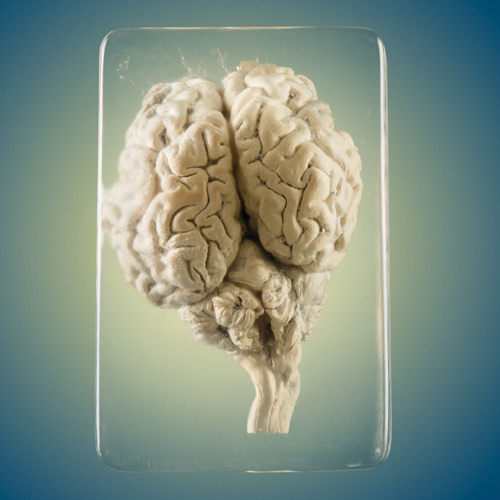
I used to research enzymes from cow brains, so I would have to drive to the slaughterhouse to pick up the brains. This was one that we didn’t need, so I used formaldehyde and set it in resin to make a paperweight. Mostly in the lab we work with slices of rat brains in a petri dish, so this reminds me of brains as a real, intact thing.
My heroes [he points to a series of photos lining the office’s window]. Those are people that inspire me. There are some pacifists, and neuro-philsophers like Hofstadter. Turing, who founded the whole field of artificial intelligence.
It’s an overhead view of Arizona or New Mexico that I shot from a plane window [he points to a large aerial photo]. Thoughts are like water coming down. The clouds are the sensory input. Then there are ridges, and if the water comes down on this side, it goes this way. If it comes down the other side, it goes the other way. In our brains, if a thought goes one way, we might stay home from work. If it goes the other way, we go to work. So the ridges are like a decision mechanism in the brain. The question that we’ve been asking is: What’s gravity in this metaphor?
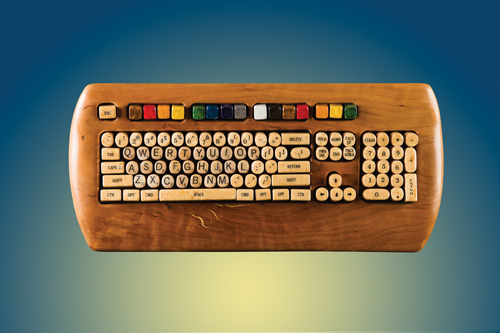
I made my own keyboard. I carved the base out of a big block of cherry. The keys are maple, and the tops are Scrabble tiles. I found a company that sells old clicky keyboards and built it onto that. It really clacks, like the one I learned to program on. The keyboard took me over a year of weekends here and there. I had to engineer the systems for tooling the keys. There was a lot of trial and error.
This department is unique. Emory has fantastic neuroscientists. Georgia Tech has fantastic engineers. I consider myself a neuroscientist and an engineer, and I didn’t want to give up either. I’m delighted to be in a place where I can do one on one day and the other the next.




 Twitter