


All over campus, researchers are looking to the wild kingdom for insight into complex questions of motion and behavior. Here are three of the many labs in which work revolves (and slithers and scurries) around animal locomotion.
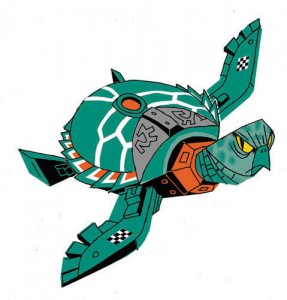 The CRAB Lab
“Most biophysicists study things at the cellular and molecular scale, but there are a few of us who are beginning to study biological systems, particularly locomotion on a larger scale,” says Daniel Goldman, assistant professor in the school of physics, adjunct professor in the school of biology and head of this aptly named research group. (CRAB stands for “Complex Rheology and Biomechanics.”)
The lab’s subjects include sea turtle hatchlings, fire ants and (of course) crabs—any creature, in Goldman’s words, “really good at doing what they do.” His team studies how animals move through complex materials, like sand. CRAB researchers aim to apply their findings to physical models, with the hope of developing applications in the human world.
Most notably, work with a motor-driven, sand-swimming device modeled on the sandfish lizard led to breakthroughs that may assist in the development of unmanned first-responder units capable of moving more easily over uneven terrain—like hurricane or earthquake debris—that poses a challenge for most robotic vehicles.
Hu Laboratory for Biolocomotion
David Hu’s research into the physics of wet-dog shaking and mosquitos’ ability to dodge raindrops has earned him press from Good Morning America, NPR, and even the esteemed Georgia Tech Alumni Magazine. In early 2012, Hamid Marvi, a mechanical engineering PhD candidate and one of Hu’s advisees, made waves of his own with the development of a critter called Scalybot 2, notable for its mobility and energy efficiency.
Marvi’s design for the bot came from the hours he spent observing 20-plus species of snakes at Zoo Atlanta. Snakes’ scales and unique rectilinear locomotive patterns enable them to move over large distances while expending relatively little energy, and Marvi applied these principles to an all-terrain robot that could be used for search-and-rescue missions staged on tricky terrain. Scalybot 2, steered by a joystick, is able to automatically adjust the friction and angle at which its metal-scaled underbelly meets the ground.
Scalybot 1, which Hu’s lab debuted in 2011, mimicked snakes’ push-and-pull concertina locomotion.
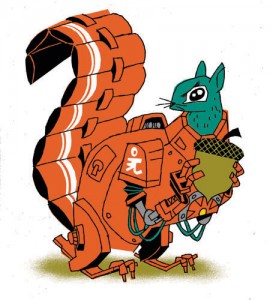 Mobile Robot Laboratory
To most observers, a squirrel’s behavior may appear completely disorganized, but many researchers—including Ronald Arkin, Regents professor in the College of Computing and associate dean for research and space planning—know better.
What looks like aimless, frantic scurrying may actually be a sophisticated method of deception. Research from the biology community suggests that squirrels are often in the process of finding nuts, hiding them in various caches, obsessively checking the safety of those caches and checking false caches (where there are no nuts at all) to mislead any sneaky critters that might be watching.
Arkin, who directs Tech’s Mobile Robot Laboratory, was inspired to mimic this tactical dishonesty in his lab, training robots to deceive both humans and other machines. “We studied how we can model both the hoarding behavior, which is gathering the nuts in the first place, and the patrolling behavior,” he says. “We implemented this in robotic systems as a resource protection strategy, tested it in simulation extensively, gathered data to show that it delays the discovery of your caches by doing this particular strategy and implemented it on a couple of robots in our laboratory.”
Arkin’s team has also looked at the bluffing capabilities of birds called Arabian babblers, which often join together in groups to harass and overwhelm a predator.
The Mobile Robot Lab’s work on squirrel and bird deception is funded by the Office of Naval Research, and its findings could be especially useful in military operations, allowing robots to assist in obscuring the location of ammunition and supplies, even allowing them to minimize the risk of capture.




 Twitter