


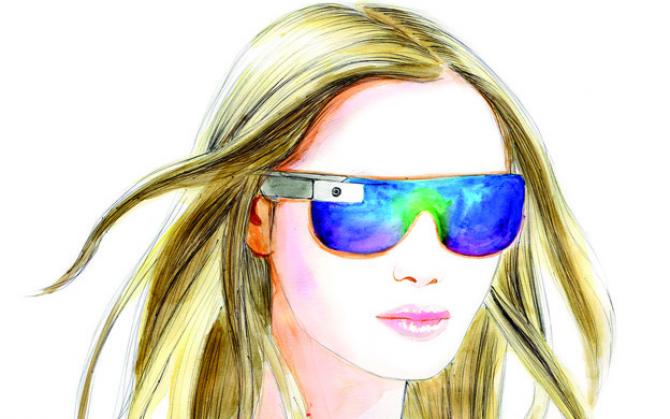
It’s been dubbed the “Year of Wearable Technology,” with 2014 marking the tipping point for computer-powered apparel and accessories in the marketplace. Scores of finally viable devices have made it into the headlines and into consumers’ wardrobes, as eyeglasses, wristwatches, gloves and other articles of clothing have increasingly been called to perform double-duty—serving not only as trendy fashion statements, but also the ultimate in connected functionality.
Not surprisingly, Georgia Tech faculty, researchers and students are helping to lead the way in wearable computing. In fact, they rank among the most experienced in the growing field, having collaboratively studied and developed wearable technology for more than 20 years. To capitalize on this expertise amid the recent buzz and cement its commitment to such research, the Institute recently formed the Wearable Computing Center. The Center aims to continue to bring together top computer scientists, engineers, psychologists, fashion designers and other experts across campus to keep Tech at the industry’s forefront.
Innovations such as Google Glass—which a Tech professor helped to develop—may seem like fads, but the reality is they’re here to stay. “This is a really exciting time for this type of technology and there’s just so much research to do,” says Center Co-Director Maribeth Gandy, CE 98, MS CS 99. “It’s a good time for Georgia Tech to expand our efforts in this realm.”

fig 1 Electronic Textile Interface (Jacket)
Fashion and computing: The two don’t typically mix, but electronic textile interfaces bring them together in a very practical way. They employ conductive embroidery sewn onto fabric to control electronic devices: Imagine changing the song on your iPod by touching your jacket sleeve. Using traditional fabric swatch books as a model, Tech researcher Clint Zeagler can demonstrate to fashion designers all the cool things these interfaces can do.
The Wearable Computing Center will also straddle the line between academia and the private sector, providing consulting services to businesses interested in taking advantage of the latest technologies. Center Co-Director Peter Presti, CS 96, MS CS 06, says Tech researchers have skills and experience that few other universities can offer. “When companies come to us, they come from a background of ‘this is new and exciting and we’ve never heard this before’,” Presti says. “Well, of course, we at Tech have been in the field for decades.”
The applications for wearable computing technology aren’t limited to trendy consumer gadgetry. For example, modern, large-scale farming operations use a lot of high-tech machinery such as aerial drones, Gandy says. “Ag companies are often making real-time decisions on what to do in the field,” she says. “Wearable computers give workers a hands free, always-on interface to stay connected to the ecosystem of technology they’re using.” Presti adds: “Georgia Tech truly stands at the nexus of this progression in wearable computing as it moves forward.”
Read on to find out more about some of the Institute’s top researchers in the field and about their groundbreaking wearable technology.
AHEAD OF HIS TIME
Tech Professor Thad Starner was about 20 years ahead of his time. In 1993, just as most households finally accepted that desktop PCs were a worthwhile investment, Starner was already wearing a portable computer he designed himself. A student at MIT at the time, Starner’s motivation to create this unconventional computer was not fame or fortune. He simply wanted to create a way to better retain the complex material from his class lectures.
He found that when he brought his laptop computer to class, he was able to take good notes—but he couldn’t look up from his screen while he was typing. If he instead focused on listening to the professor, he would understand the day’s lesson, but have trouble recalling the information later.
So he designed a wearable computer that would allow him to do both. With an eye-level display, he could see both the classroom blackboard and the computer display in his field of vision. From the time he first completed this precursor to Google Glass, Starner was almost never without his personal wearable computer.
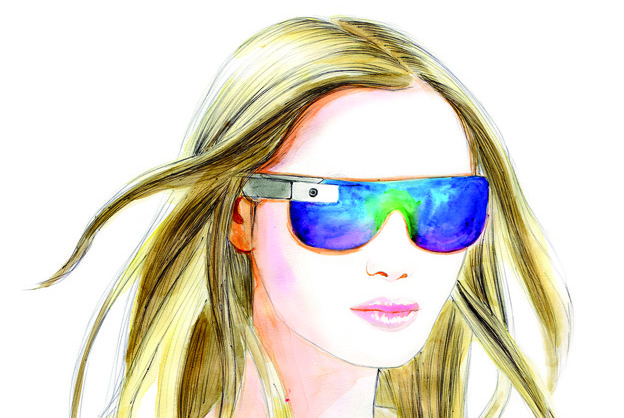
fig 2 Google Glass
Google Glass is the diva of the wearable computing world. Developed with guidance from Georgia Professor Thad Starner, Glass gained considerable buzz in 2013 during beta testing. Still only available as an experimental model, Glass is a glasses-mounted, hands-free computer that projects data and images right in front of your eyes, allowing you to walk and talk and compute while using it.
In its earliest incarnation, the display attached to his eyeglasses obscured most of one eye from view. He carried the equipment in a heavy shoulder bag strapped around his chest, and typed on a one-handed keyboard called a Twiddler.
Needless to say, he often attracted attention, especially from his peers at computing conferences.
On one such occasion in 1998, two guys asked Starner if he would give them a demonstration of his mobile computer.
Their names were Larry Page and Sergey Brin, and they told him they were starting a new search engine. Using his wearable computer, Starner typed up some quick notes about their conversation and got their email addresses to stay in touch.
To this day, Starner uses his wearable computer to take meticulous notes on everything from professional engagements to casual conversations. He has about 20 years of such notes stored on the machine, and he’s devised a cataloguing system that allows him to easily call up relevant notes that will add to his conversations.
The notes from that encounter proved to be especially useful. That new search engine? It’s the juggernaut we know today as Google.
“That’s one personal, early example of wearable computing being pretty important and pretty life-changing,” says Starner, who joined the faculty of Tech’s College of Computing in 1999.
In 2010, Starner reconnected with the guys from Google, and they decided the time was right to start developing a heads-up display for the mass consumer market. A heads-up display is a device that transparently projects images or information directly onto a user’s field of vision, so it can be seen layered on top of the background. Starner partnered with Google as a technical lead on Project Glass.
Think about Starner’s early wearable computer. Most people wouldn’t be too interested in lugging around a 5-pound sack of electronics, regardless of what cool things it could do. And the head-mounted display? Forget it, Starner says. At the end of the 20th century, many people were still not convinced of the need to own a personal computer, much less wear one on their face.
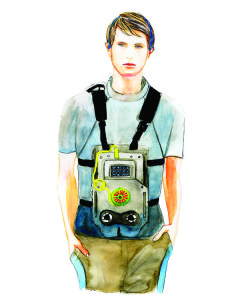
fig 3 CHAT
We know dolphins are smart. But it’s been difficult to fully understand them. Cetacean Hearing Augmentation & Telemetry, or CHAT, is an underwater wearable computer, developed by Tech students and faculty including Peter Presti and Thad Starner, that allows marine biologists to record and transmit whistles for two-way communication experiments with
our mammalian friends.
“If you look at how we were using these systems in the 1990s, it’s how people are using their cellphones today,” Starner says. “There was no such thing as a Palm Pilot, there was no such thing as a smartphone. Laptops were barely known.”
But a lot has changed since the ’90s.
People eventually embraced mobile devices that allowed them to send text messages, check emails, update their calendars, find destinations with GPS navigation, listen to music and much more. The technology itself has also improved in many ways—including both affordability and sturdiness—making the idea of wearable computers more realistic for lots of consumers.
In addition, batteries have gotten lighter and last longer, cloud computing makes data storage easier, and Wi-Fi and Bluetooth make wireless devices much faster and more convenient. All of these technologies are somehow packed into devices like Google Glass, says Starner, which is no heavier than your average pair of sunglasses.
“The infrastructure caught up with what we were trying to do,” Starner says.
For Starner, wearable computing is an exercise in minimalism. Google Glass augments reality, rather than distracts from it, providing assistance to the user while they engage in other tasks. Say, for example, you’re traveling and want to find the nearest coffee shop. Rather than stopping to take your smartphone out of your pocket to consult a navigation app, you could keep walking and have Glass display directions to the nearest shop.
“Any fancy interfaces, fancy graphics, you want to get out of the way,” Starner says. “So the device becomes an extension of yourself.”
By having the computer on your body, you’re able to continue about your business and find the information you need faster, he says. “It shortens the time between your intention to do something and your first action,” Starner says.
EVEN A SHIRT CAN BE SMART
Starner was not the only Georgia Tech professor making waves in the wearable technology field in the late 1990s.
Sundaresan Jayaraman, a professor of materials science and engineering, changed the way people looked at fabrics when he unveiled a prototype of his “wearable motherboard” smart shirt to Peter Jennings on ABC’s World News Tonight in 1997. From there, he appeared on CNN, BBC and Discovery Channel. The high-tech undershirt was featured by Newsweek magazine as one of “10 Inventions That Will Change the World.” Life magazine highlighted the smart shirt as one of its “Medical Miracles for the Next Millennium.” And Time magazine named the Smart Shirt one of the “Best Inventions of the Year
for 2001.”
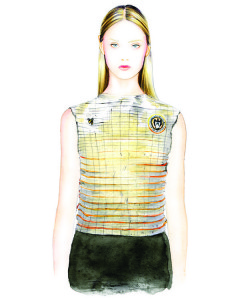
fig 4 Wearable Motherboard
This is no average T-shirt. Dubbed the wearable motherboard, this smart shirt designed by Tech’s Sundaresan Jayaraman is woven with conductive fibers that allow it to use sensors and processors to monitor an athlete’s performance or alert parents if a baby stops breathing, and much more. The first prototype, illustrated here, is now housed at the Smithsonian.
All of this buzz centered on the radical idea that textiles could be a platform for electronics.
The smart shirt project began at Tech as DARPA-funded research to investigate ways to minimize casualties for soldiers on the battlefield. Jayaraman and his team came up with a shirt, made using a high-tech loom, woven with optical and conducting fibers throughout that would be able to read the wearer’s vital signs and detect injuries, such as bullet wounds, if the fibers were broken.
In developing the technology, Jayaraman and colleague Sungmee Park, MS TE 95, wove electronic fibers into fabric to create a shirt capable of many different functions. It was dubbed the wearable motherboard because, like a computer’s motherboard, you could switch out the sensors and devices to perform different functions.
It was the first time anything like it had ever been created, and this early prototype is now housed in the Smithsonian Museum’s permanent collection.
The wearable motherboard, which looked something like an undershirt made of papyrus fibers and glowsticks (though still surprisingly soft), proudly boasts its Georgia Tech genesis. Sewn on the right breast is a patch of the official school seal. On the left, a small likeness of the Yellow Jacket
mascot, Buzz.
Jayaraman still envisions a world of possibilities for the wearable motherboard. In the nearly 20 years since that first media blitz, he has continued his research and developed the technology in his lab at Tech.
In 2000, Georgia Tech licensed the technology to a startup company that planned to create items for the consumer market, but commercialization never got off the ground. Last year, Tech was able to reacquire the license, and Jayaraman says plans are underway to work with a new company to get products using the technology out on the market.
With its versatile nature, Jayaraman envisions many different uses for the wearable technology. It could be used by athletes during training to record performance, by the medical industry to track the health of patients, and by firefighters to let them know when temperatures become lethal.

fig 5 Wearable Computing Gloves
It sounds too good to be true: Put on a pair of gloves, sit back and now you can play the piano. Or read Braille. Tiny vibrating motors inside the gloves developed at Tech teach motor skills through a technique called passive haptic learning.
“It has applications throughout the continuum of life,” Jayaraman says. “The possibilities are really endless. It’s all driven by need.”
One of the first products he hopes will be available for consumers is a one-piece baby outfit. The baby jumpsuit would be made of soft cotton and feel no different than any other baby clothes, but it would be equipped with sensors that could alert parents if an infant stops breathing. In that respect, it could be a powerful tool to combat Sudden Infant Death Syndrome, better known as SIDS, Jayaraman says.
Following the initial publicity surrounding his technology, Jayaraman was contacted by heartbroken mothers who had lost babies to SIDS. They wanted to know how they could get his baby clothes to prevent that tragedy from ever happening again.
He says it was very difficult for him to know that he had designed something that could potentially save lives but couldn’t legally make it available to the public. The cause remains close to his heart, and Jayaraman says he is optimistic that this new commercial endeavor will be successful.
Jayaraman says one of the reasons he loves textiles is because they are not only functional, but beautiful. And he firmly believes textiles will be an important part of the future of wearable computing.
“When you think of the word ‘wearable,’ the first thing that comes to your mind is clothing,” Jayaraman says. “When you think about textiles, it’s the ultimate framework or infrastructure you have. You’ve got the fluidity of art, and the rigor of science. When those two come together, it’s pure joy.”
MAKING WEARABLE TECH FASHIONABLE
As an undergraduate student at Georgia Tech, Clint Zeagler, ID 04, was blown away by the wearable motherboard designed by his professor, Dr. Jayaraman. The smart shirt combined two things he was passionate about: fashion and human-centered computing.
“That’s part of the reason I got so excited about wearable technology,” Zeagler says.
Zeagler, now a researcher at Tech himself, works to bridge the intersection of art and science. His research revolves around what he calls on-body interfaces, many of which are textile-based.
One of his major projects is conductive-thread embroidery: a pattern embroidered onto a garment, like a jacket sleeve, which can be touched to control electronics.

fig 6 FIDO
This doggy acronym stands for “Facilitating Interactions for Dogs with Occupations.” Wearable technology for dogs? Yep. Working dogs, like those that sniff bombs or assist people with disabilities, are limited by how much they can communicate with humans. So Tech researchers created sensors for a working dog’s vest that the dog could use with biting, tugging and nose gestures to better communicate with their handlers.
“If I’m walking down the street, instead of having to pull out my phone to answer a telephone call or hang up on a telephone call or change a song, I can reach and touch the embroidery on my sleeve and control those things,” Zeagler says. “And because it’s embroidered, it’s raised up and I can feel it without having to look at it directly.”
What separates Zeagler from many of his colleagues in the computing world is that he has some serious fashion credentials.
After graduating from Tech with a bachelor’s degree in industrial design, Zeagler headed to the fashion capital of Milan, Italy, to study at Domus Academy, where he earned his master’s degree in fashion design. Back in Atlanta, he started his own clothing line, Pecan Pie Couture, selling organic women’s fashion T-shirts.
He’s a passionate proponent of wearable technology and works to emphasize the “wearable” part as essential to the success of the field. “Part of my goal is that I love the stuff that the craft movement is doing and the DIY enthusiasts are doing with wearable electronics,” Zeagler says. “Part of my goal is to see real mass-market applications. And to do that, you have to find a way to explain your story to the fashion designers and the fashion business engine.”
Fashion designers go to trade shows and get fabric swatch books with samples of different patterns and textures that they can take back to their studios and use for design inspiration. Zeagler says it’s difficult to introduce on-body interfaces to fashion designers in the same way that you would with traditional fabrics.
Showing up to a fashion design studio toting a piece of fabric with a bunch of wires hacked onto a breadboard just wouldn’t cut it, he says. Even if it worked beautifully, it would look awkward and intimidating to someone who isn’t familiar with computing.
Zeagler created an electronic textile interface swatch book as an easy, accessible way to introduce and demonstrate wearable technology to fashion designers. “We wrapped it up and packaged it so it was an easy plug-and-play system that hooked up to a laptop. You could see the swatch, play with it, and then plug in another one,” he says.
Zeagler likes wearable technology because it encompasses a mix of function and expression.
“Anything that we put on our bodies, that we wear, we make a choice to do that and it says something about ourselves,” he says. “Inevitably there’s a fashion element or a style element to anything we decide to wear, even if it’s an anti-fashion statement.”
Zeagler is one of the Tech researchers, along with co-directors Gandy and Presti, working to help kickstart the new Wearable Computing Center. He says that mix of influences in wearable technology—from design to computing to psychology to business—makes it an area that’s perfectly suited for multidisciplinary collaboration.
“Lots of people come to Georgia Tech because wearables are so in the news right now and because we have such close ties to the wearable community,” Zeagler says. “The hope is that the Wearable Computing Center will be a hub for collaborative projects across campus that have to do with wearable computing.”
Center co-directors Gandy and Presti say it may seem as if the Center sprang from the recent popularity in wearable technology, but again stress that it’s actually rooted in the many years of research and development that’s placed Georgia Tech on the cutting edge of the movement.
With Google Glass, wearable computing now has a very recognizable poster child, and one of Tech’s own played a huge role in its development. “Just having a large, respected company put their stamp of approval on wearable technology is very impactful,” Gandy says.
There are other companies out there working on head-mounted displays, but Google is the largest and best recognized. Gandy says before Google introduced Glass, it was harder to get people interested in considering wearable technology.
“When I would show people demonstrations on a head-mounted display, they would say, ‘This is kind of weird, I don’t know that I would want to wear this,’” Gandy says. “It was Google saying ‘It’s OK, this is the future.’”
Another big-name company getting involved in wearable computing is Facebook.
In March, the social media giant purchased Oculus VR, the maker of the Oculus Rift virtual reality headset, for $2 billion.
In a memo posted on the social media site, Facebook CEO Mark Zuckerberg explained his interest in acquiring the seemingly unrelated company. Oculus Rift was developed as a headset to play immersive, virtual reality video games and has been very popular with game developers even though it has yet to hit the consumer market. Zuckerberg says under the Facebook flag, Oculus will continue as a gaming platform but will eventually be expanded to include new social applications— Zuckerberg’s wheelhouse.
“After games, we’re going to make Oculus a platform for many other experiences,” Zuckerberg wrote in his March 25 memo. Imagine enjoying a court-side seat at a game, studying in a classroom of students and teachers all over the world or consulting with a doctor face-to-face—just by putting on goggles in your home. This is really a new communication platform. By feeling truly present, you can share unbounded spaces and experiences with the people in your life. … One day, we believe this kind of immersive, augmented reality will become a part of daily life for billions of people.”
With the purchase of Oculus, Zuckerberg demonstrated his belief that wearable technology is the next frontier. “Virtual reality was once the dream of science fiction. But the Internet was also once a dream, and so were computers and smartphones,” Zuckerberg wrote.
Researchers don’t know for sure where the future of wearable technology is headed. But most agree that regardless of what incarnation it will take, wearable technology will hold a place in our lives.
Tech’s Presti says that while it’s fascinating to try to imagine it, it’s almost impossible at this point to know how the technology will evolve. “Trying to predict where wearable computing will go in the next 10 to 15 years is like forecasting in 1995 where the World Wide Web would go,” Presti says. “Regardless, we at Tech are excited to play a major part in its future.”




 Twitter