


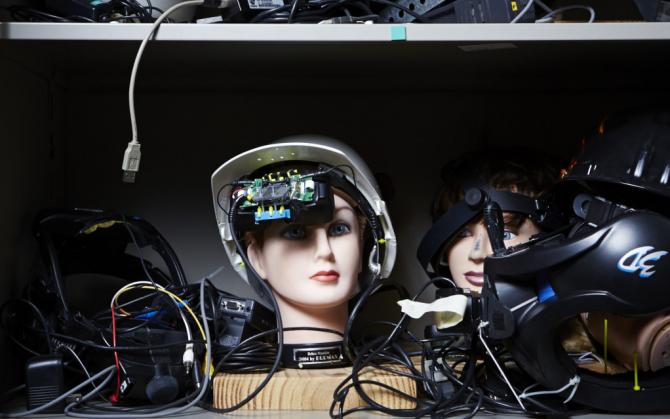
Georgia Tech’s burgeoning Game Studio is emerging as a leading hub of video game research and development under the direction of professors Ian Bogost and Blair MacIntyre. The dynamic duo started the Studio two years ago to explore the myriad ways gaming can be a critical tool for teaching and training, in addition to its existing role as a popular mode of entertainment.
Make no mistake: Mass-market video games are big money. Last September, Grand Theft Auto V, the latest in the popular franchise from Rockstar Games, sold $800 million worldwide in 24 hours—the most successful launch of any entertainment property ever. That includes movies, records, you name it. For comparison, it took four weekends for this summer’s Transformers movie to hit $800 million. To put it simply, video game revenues dwarf the box office and most other forms of entertainment.
Based on the immensity and longevity of the gaming industry, it makes perfect sense for two of the industry’s leading researchers to set up shop at one of the world’s top research universities and try to push the medium forward. And that’s exactly what Bogost and MacIntyre aim to do.
“We’re really interested in stopping and thinking about where gaming is today,” Bogost says. “It’s important to look back historically at where gaming has come from, and then look forward to see where it might go in the future. All kinds of new opportunities exist for video games.”

Blair Macintyre (left) and Ian Bogost use the Game Studio environment to challenge the way students think about gaming. Macintyre is a professor of interactive computing at Tech and director of the Augmented Environments Lab. He has been conducting augmented reality research since 1991. He’s also the co-founder at Aura Interactive LLC., a game design and consultancy firm. Bogost is the Ivan Allen College Distinguished Chair in Media Studies and a professor of interactive computing at Tech, where he also holds an appointment in the Scheller College of Business. In addition, he is founding partner at Persuasive Games LLC, an independent game studio, and a contributing editor at The Atlantic.
This combination of theory and practice is something that Bogost and MacIntyre are trying to bring into the studio environment. “It’s very, very, very different than the vast majority of activities that take place at an institution like Georgia Tech,” Bogost says.
And it’s an approach Bogost and others had back in 2005 when they co-wrote an article for the International Digital Media and Arts Journal titled “Asking What Is Possible: The Georgia Tech Approach to Game Research and Education.” University-based game development programs, he and his co-authors wrote, tend to focus on two separate activities: game production, which has traditionally fed the industry with workers who have the skills and understanding needed to bring a game to market, and game studies programs, which analyze the gaming environment in a research-oriented and theoretical way.
Georgia Tech would be different, they wrote: “We at Georgia Tech want to challenge both of these categories. … If the Game Production programs rally around the cry ‘You play games, now learn to make them’; and if the Game Studies programs declare, ‘You play games, now learn to study them,’ then we might respond, ‘You must make games to study them, and you must study games to make them.’”
It would take seven more years, however, for the Game Studio to get off the ground. In 2012, Georgia Tech alumnus and generous benefactor Chris Klaus, Cls 96,
suggested to the provost that his alma mater might want to support more student game creation. After all, the University of Southern California and New York University both have successful game design schools. But neither is a top-tier research university with a pool of 21,000-plus technically adept students to draw upon.
“We have awesome students,” says MacIntyre, the Studio’s co-director. “Because they’re so good technically, they’re unafraid to try things that might be too hard for most others, those who are more into the storytelling or look and feel, for instance.”
Given the intersection of technical expertise, engineering and art that make up the video game creative process, MacIntyre compares programming to painting. If you’re trying to paint, but you’re not technically skilled, you’ll focus on the brush strokes and the thickness of the paint. You’ll worry whether you’re getting the sky just the right shade of blue. You’ll lose sight of what you’re trying to create.
“If you’re still not able to make the paintbrush do what you want,” he says, “then it’s hard to paint.”
MacIntyre adds that because GT has such institutional expertise in programming and problem solving, the programming—the digital paintbrush, as it were—doesn’t get in the way. “Because the students are so technically adept, they can explore a different kind of collection of games, and they can do it much more rapidly, so it lets us do this kind of rapid prototyping, new prototypes every week.”
Bogost agrees. “That mentality, that sort of engineer’s mentality, is something that’s uniquely present at a place like Georgia Tech,” he says. “Our students are particularly open and open-minded about solving problems, which is one of the things that we would like to see more of our games do.”
Current students and alumni working in the video game industry agree that Tech’s approach to rapidly iterating ideas and problem solving—both engineering traits—are competitive advantages. The emphasis on completing projects and producing finished products, something that’s commonplace throughout Tech, doesn’t hurt either, Bogost says.
GT alumni in the gaming industry agree. “A lot of times, games are based on interactions and iterations that you can’t really foresee,” says John Bernhelm, CM 08. “Everything you’re doing is a little experiment towards what you’re hoping to achieve. An education at Tech reinforces the need for such an approach. And sometimes you stumble upon really neat interactions and fun things, even if you’re trying to make a statement, such as really poignant interactions that can really make your game.”
Bernhelm, 32, graduated before the Game Studio was launched, and now works at a studio in San Francisco called Double Fine Productions. Some of the games he’s worked on include a sci-fi noir mystery where you investigate your own death, a sci-fi building simulator, as well as a number of motion-activated games for Microsoft’s Xbox gaming console. One of Double Fine’s wittier games is Middle Manager for Justice, in which you play a middle manager of superheroes. You recruit your heroes, train them and send them out to fight crime. It’s a bit like being the HR supervisor for the Justice League, and it’s more fun than it sounds.
Bernhelm’s experience at Georgia Tech as a computational media student gave him time and space to experiment and develop the skills he has today. And while he didn’t get to take part in the Game Studio himself, he’s very supportive of its mission to find the unexpected benefits of games in society and how they can do more than entertain.
“I think a lot of my friends who got into this, it’s because we grew up playing Nintendo,” he says. “We do really love games as a medium, but you see artists come out of that and you see scientists and occupational behaviorists come out of that, and that’s really interesting.”
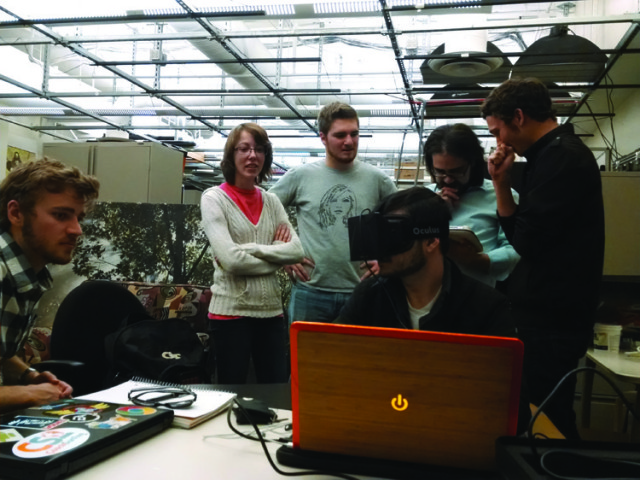
Georgia Tech students [l to r] Miranda Bradley, Paco Swift, Kyle Blevins and A.J. Kolenc discuss a Virtual Reality game prototype with Bogost. Other members of the Studio this past year include Chris DeLeon, Matthew Guzdial, Adam Le Doux, Marc Huet, Sebastian Monroy, Rose Peng, Daniel Xiao and Bobby Schweizer.
“Having students learn from a teacher and then getting to put what they’ve learned into active practice is a much more solid way to get that knowledge into their head as opposed to just rote memorization,” Bradley says.
Gamification is happening with everything from language learning to easing mental depression or anxiety. For example, Bogost has developed games about public policy, seasonal and pandemic flu, airport security, immigration, the politics of nutrition and many more. In 2010, he published a book on games and journalism, Newsgames: Journalism at Play, written with former Tech Digital Media graduate students Bobby Schweizer, MS DM 09, PhD DM 14, and Simon Ferrari, MS DM 10.
Similar techniques have been around for years under various names—first as “edutainment” in the 1980s, and later as “serious games” in the 2000s. But even as trends like gamification rise and fall, games have yet to secure a permanent position as a sober and important mode of communication. There’s still a faint stigma, a whiff of frivolousness, attached to playing computer games—much less researching them—at a publicly supported university. That can make game research an uphill battle at times.
“There’s definitely a stigma,” Bogost says. “And what’s weirder about the stigma is that today more people play computer games than ever have before.” The difference? They don’t self-identify as “gamers” like the kids holed up with Halo on the Xbox or the World of Warcraft obsessive, he says.
“It’s like anything else in my life,” Bogost says. “I’m not a magazine-reader or a film-goer as my primary identity, but those are things that I do.”
Such criticisms are nothing new. Electricity and telephones were railed against in the journal Nature in 1889. The printing press was an upstart evil to a 15th century abbot. And in the dialogue Phaedrus, circa 370 BC, Socrates—Socrates!—warned against the written word: “For this invention will produce forgetfulness in the minds of those who learn to use it, because they will not practice their memory.” Video games as a waste of time and a cause of moral decay among the world’s youth have some good company.
“People are always questioning that kind of stuff,” says Adam LeDoux, 22, one of Bogost’s students who is interning at Microsoft in Seattle. “But for games, if you just look at how much playing games is a part of human life, then it can seem evident why it’s significant. It’s one of the first ways people learn; it’s how you get used to being in the world.”
Bogost is obviously quick to dismiss the idea that games are merely child’s play. But he is also eager to move beyond what he sees as just the technical advancement in graphics and processing power that are the usual signals of advancement with modern gaming. A focus on technical innovation is not the same as innovation in the use and adoption of games and how they fit into our lives, he says
Which brings us back to the Georgia Tech Game Studio and its mission. To research these other innovations and the gamification of our lives, Bogost thinks that someday, perhaps we’ll find that games have just become part of everyday living. Or perhaps our normal lives will have become games.
“Games are going to become just this ordinary, everyday media experience,” he says. “And that’s actually how we’ll know when we’re successful, when it’s not a big deal to be making games for various purposes.”
From titles that teach us new languages or help us become better people, or those that explore how the political system works or train EMTs to save lives, playing them is a profoundly human experience, Bogost says.
And gaming is something we do from the day we are born almost until the day we literally run out of lives. It makes little difference if the games are played on the playground (which teach teamwork and leadership) on the tabletop (strategy and planning) or on the computer (anything at all).
Researching that—the way games and play can teach us, challenge us and make us think—is certainly worthy of a great research institution like Tech.




 Twitter