


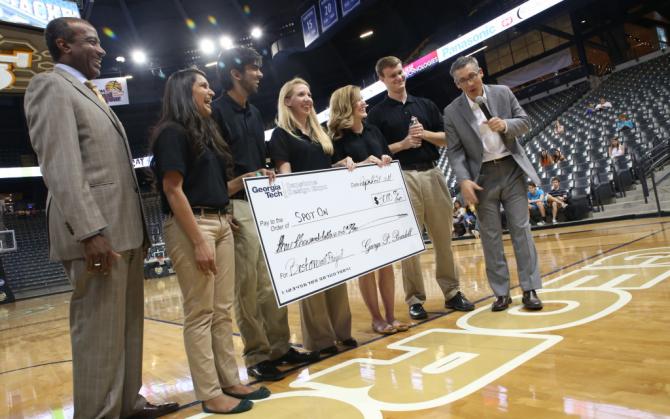
If you fractured your femur, a doctor would likely insert a rod into your bone shaft to hold the bone together and help it heal. It’s an effective solution, but the process of inserting the screws to hold the bone and rod together is difficult. And because radiation is involved, it’s also somewhat risky. Or, at least, it used to be: In tandem with the medical company Smith and Nephew, a team of five Georgia Tech students last year—working together on their Senior Capstone Design Project—developed a simple, low-cost technique to help overcome these challenges.
Thanks to the Capstone Design Project’s emphasis on real-world development, these students didn’t work on the problem in a vacuum. They talked to doctors, studied cadavers and tested numerous options. After zeroing in on the best solution, they built a successful prototype that required no radiation. The product and the technique they developed has the potential to benefit people who often cannot afford expensive medical care. And although her team can’t discuss the project in depth—thanks to a nondisclosure agreement with Smith and Nephew—Elizabeth Morris, BME 14, says the company was “thrilled with their work.”
Indeed, the Senior Capstone Design Project has been reimagined and overhauled over the past several years. Today’s projects give students a chance to build prototypes, tackle true-to-life challenges and work closely with industry partners and students from other majors. “Through the Capstone Design Project, we want to give students the resources—time, funding, space, support—to turn their inventions into real commercial devices,” says Bioengineering Associate Professor Craig Forest, ME 01, who helps direct the project curriculum.
Once a project that could be completed with simply a series of academic papers, PowerPoints and poster sessions, the Senior Capstone Design Project garnered little student interest in the past. “For most students, it was just one more thing to check off their list before graduation,” admits Amit Jariwala, director of design and innovation for the School of Mechanical Engineering. “Now it’s a springboard for them to show employers what they’re truly capable of, or perhaps even an entry point into becoming entrepreneurs.”
To boost student enthusiasm—and position graduates well for future jobs—Jariwala and Forest, with support from the administration and other faculty, began making systematic improvements. They created an Invention Studio for students to build prototypes and gave all teams budgets of $500 to make their project come alive. They invited industry sponsors to share some of their toughest problems and benefit from Tech’s student brainpower. And perhaps most important, they created a Capstone Design Expo at the end of each semester where students presented their projects to visitors, judges and potential future employers.
The process is both demanding and inspiring. Students form a team—usually four to six students from a variety of disciplines ranging from engineering to business to public policy—and a project based on their own interests or industry requests. They conduct extensive market research and work closely with fellow students, faculty and industry experts to hone their projects.
The teams find out quickly that the technical aspects of the projects aren’t the only challenges that they face. “Our team was comprised of people from not only different majors, but also backgrounds and cultures, and there were some communication issues” says Aditi Chandak, ME 14, whose Capstone Project aimed to reduce noise produced by tools in aircraft manufacturing. “But I think our diversity of experiences also allowed us to pursue many more ideas than we would have otherwise.”
While many students are used to learning alone and being graded for individual performances, Capstone Design teams replicate the kind of collaboration that students will need to succeed in jobs after graduation, Jariwala says.
Interest in the projects—and the Expo—has soared. Five years ago, the Expo consisted of fewer than 30 teams, all from the School of Mechanical Engineering. Last spring, the event attracted 170 teams that included students from nine different majors. More than 5,000 people, including dozens of industry recruiters, attended. The Expo was even covered by local television, radio and newspapers.
The teams competed for a top prize of $3,000, but the potential impact is far greater than the one-time financial reward. Chandak’s work with aircrafts, for example, helped her land a full-time position with Boeing Commercial Airlines. Another team, which developed a machine to help basketball players take practice shots more efficiently, has submitted a provisional patent application and has attracted investor interest.
Though the results have been significant already, Jariwala and Forest agree that there are even bigger possibilities down the road. Forest wants students from every major in the school to participate, and he hopes to increase collaboration between students campus wide. He’s ready to add larger spaces for a machine shop that’s currently bursting at the seams. And he wants to increase the number of industry sponsors. “We want to turbocharge these activities,” he says. “We want to be the national leader in entrepreneurial and invention activity.”
This story is the first in a four-part series on Georgia Tech’s Capstone
Design Project.


 Twitter
Pingback: Launching Pad | Erin Peterson