


Take a walk around a home-improvement store, and you’ll see plenty of product tags advertising ways you can reduce spending on your utility bills—and your carbon footprint. But going green and saving a bit of money by using Energy Star appliances, smart thermostats or compact fluorescent light bulbs is just a drop in the proverbial bucket.
What if your house or apartment could produce enough energy to balance out the amount it consumes?
It’s called net-zero energy design, and it’s a growing movement in architecture. A net-zero building is not only specially engineered to maximize energy savings, but also generates its own renewable energy—through methods such as solar panels—to cancel out the consumption of electricity and gas.
“It’s very easy to be energy efficient these days,” says Michael Gamble, M Arch 91, associate professor of architecture at Tech. “However, I would say there’s sort of an 80/20 rule. It’s the 80 percent effort to achieve energy efficiency that’s pretty easy and inexpensive. The last 20 percent of working toward net-zero energy consumption—or even positive energy generation—is where it gets much more challenging.”
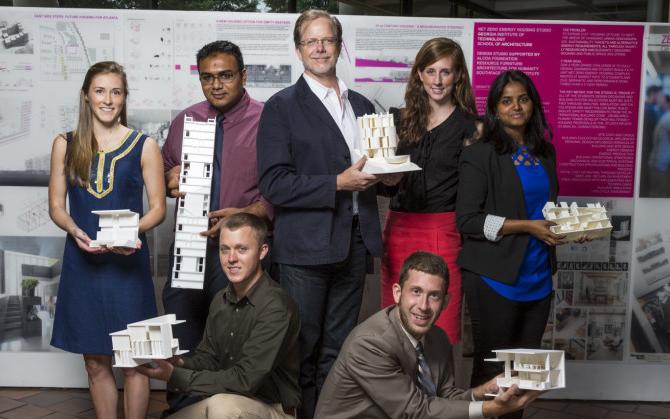
Gamble is working with fellow Tech professors Godfried Augenbroe, Daniel Castro, Russell Gentry, Jason Brown and recent alumnus Stephen Taul, M Arch 12, M CRP 12, to lead a group of graduate architecture students on a three-year project to design, build and eventually occupy a net-zero energy apartment building near campus.
Gamble says Tech students certainly aren’t the only ones attempting to create net-zero energy buildings today. But what makes this project unique is that they are tailoring their designs specifically to the challenges of modern, urban life in Atlanta.
Like other major cities around the country, Atlanta’s in-town neighborhoods are booming as more people, especially young people, move into the core of the city to be closer to jobs and entertainment and reduce their dependence on a car to get around. However, traditional single-family houses aren’t very practical for city life, where land is at a premium. As cities grow, the price of real estate rises too, making it harder for people to afford single-family houses.
“For the city to be affordable, there’s no escaping higher density,” Gamble says. “In most instances, that affordability is going to be achieved not through single-family houses, but through multi-family housing.”
And that’s the real ambition of the studio: to intersect affordability and energy balance, he says. “We’re trying to help our students understand all the forces in play around the debates and be savvy designers in the process.”
There are several ways to approach net-zero energy building. In Atlanta, the most practical tools for generating renewable energy are solar panels—thanks to its very sunny climate—and ground-source heat pumps. These pumps use the constant temperature of the earth as a bank, taking heat from the ground when it’s cold, or storing heat in the ground when it’s hot.
Smart, energy-conserving design is also critical to success, whether it’s building placement, systems efficiency or overall insulation and sealing. “The first line of defense in any efficient building or net-zero energy building is a well-insulated building envelope,” Gamble says.
The students’ early work has captured the attention of the international architecture and design communities. This past year, their models and drawings have been featured in several exhibits, including the Museum of Design Atlanta’s “Design for Social Impact.” Gamble says Georgia Tech was one of few universities invited to present student work at the “Dwell on Design” exhibit in Los Angeles this summer. And in the fall, the students will take their work on the road again to present it in New York.
At the end of the three-year project, students will participate in building a 12- to 20-unit building based on their designs. Though no site has been selected yet, Gamble hopes that it will be built near Georgia Tech’s campus.
Once completed, the plan is for students to live in it and test its performance first hand. Individual living habits introduce a lot of unexpected variables into the net-zero energy equation, Gamble says. “It can be difficult to ensure a home actually achieves the net-zero energy balance it was designed for.”




 Twitter