


It’s likely that more people have seen the buildings Justin O’Neal Miller, Arch 05, helped design than have witnessed the work of the world’s top architects. The major difference, however, is that his constructions aren’t exactly real. Miller has served as a set designer and art director for several major film and TV productions, including The Walking Dead, 42 and Hunger Games: Mockingjay Parts 1 and 2—all of which were at least partly filmed in Georgia. He takes the Alumni Magazine behind the scenes of his career as a movie illusionist.
After graduating from Tech, Miller found work at a couple leading architecture firms but got laid off during the 2009 economic downturn. Looking for a job, he used his contacts to land a gig as a neophyte set designer on Big Mommas: Like Father, Like Son, the third title in Martin Lawrence’s comedy trilogy. “It might not have been the artistic project I had always hoped for,” Miller says, “but it was a good place to start. I’m lucky to have known the right people to get my foot in the door.”
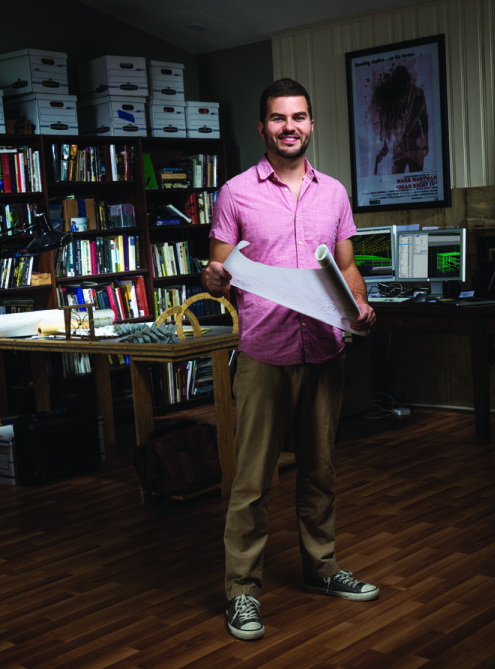
Justin O’Neal Miller at his home office. Photo by Josh Meister.
On set, Miller was surprised to find out how seamlessly his architecture skills and training would translate to the movie world. “My job as a set designer was to take the production designer’s vision—the big ideas and drawings—and turn them into something a contractor could understand and build,” Miller says. “In many ways, it was exactly what I did as an architect. I’d draw up plans using Autocad and hand them off to be constructed.”
What turned out to be very different from architecture, however, was the near-immediate turnaround on a film production. “For example, on one particular architecture project I did nothing but design doors for three months,” he says. “On Big Mommas, one morning I came into work and found a set I’d designed the night before almost done and ready for filming. That building with the doors I helped design? It took five years to complete. Maybe it’s not a fair comparison, especially since movie sets are basically illusions that don’t have to meet building codes.”
There’s certainly great satisfaction for Miller to see what he’s designed turned into reality so quickly, as well as for his sets to be seen by so many people. If you’re a TV watcher or moviegoer, you’ve more than likely have witnessed examples of his craft, which include:
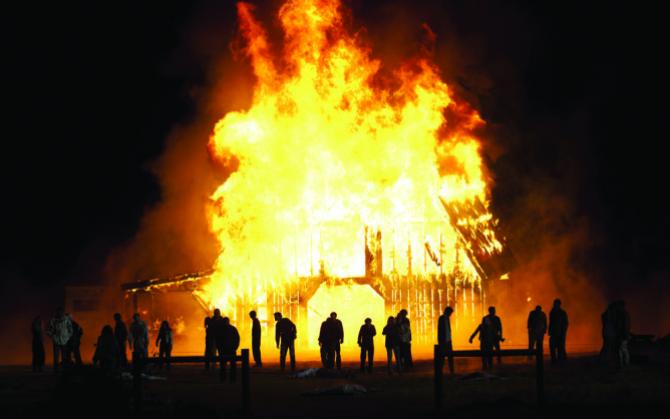
- The barn full of zombies on Hershel’s farm in The Walking Dead, which dramatically goes up in flames at the end of season two.
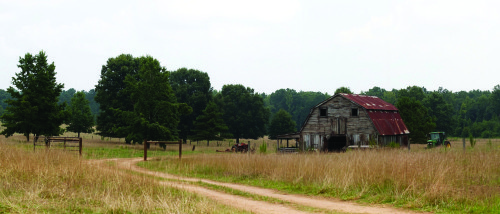
- The well Glenn had to descend into to lure a zombie away from the survivors’ potential water supply.
- The recreation of Ebbets Field for the Jackie Robinson biopic, 42, which was retrofitted into the existing Engel Field in Chattanooga, Tenn.
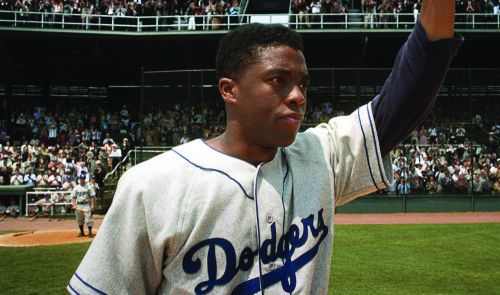
- The office of Brooklyn Dodgers owner Branch Rickey in 42.
- Mundane suburban exteriors in Prisoners, an intense indie drama starring Hugh Jackman and Jake Gyllenhaal, which was filmed in Tucker and Stone Mountain.
- Living quarters, a cafeteria, the dam, Tigris’ shop and Capitol streets in the upcoming Hunger Games: Mockingjay Part 1.
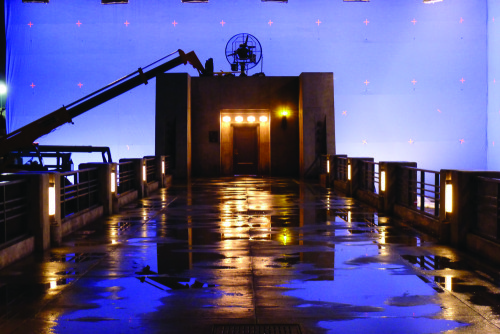
Miller truly felt like he had made the big leagues of set design when he was hired for 42, which was released last summer. “The scale of the project and size of team and the multitude of locations were what I expected from a Hollywood production,” he says. “It was also the first time where I got to see everything happen and I was more involved in the decision-making process.”
His current project is a biopic about jazz great Buddy Bolden, a cornet player idolized by Louis Armstrong. “Bolden! is set at the turn of the 20th century, and we’re trying to recreate the seedy Storyville red- light district of New Orleans,” Miller says. “The main challenge is that this world is old and falling apart, so we’ve had to use outdated building techniques to put up structures that slump and decay in authentic ways. We want this world to seem real and lived in.”
For set designers, every film project is very different and that keeps things interesting for Miller. “Mockingjay was a complete departure from Bolden!” Miller says. “Not only does it take place in an apocalyptic and futuristic world, but it’s one that’s already been described in great detail in the Hunger Games books. You have to be very careful with the design choices you make.”
Miller took a step up from set designer to assistant art director on Mockingjay Part 1, and he’s also served as full art director on other projects. However, he’s quick to point out that he’s still mainly supporting the visual wishes of the production designer and director. “My job is still deep in the details, picking wallpaper and building materials and room shapes that fit their vision,” he says.
As he looks to move up, however, he has a bigger career goal: He wants to write and direct his own movies. He’s already made two short films that have toured the festival circuits, and he’s trying to find time between set design gigs to finish a third. “I’m lucky I’ve been able to work in close proximity to directors like Frank Darabont and Edgar Wright to learn from them,” Miller says.
For now, however, he’s happy with being an art director and set designer—especially since the movie industry has become so strong in the region. “More and more productions are coming to Georgia because of the tax-incentive programs and lower cost of filming,” Miller says. “At one time I considered moving to Hollywood, but why should I do that when Hollywood has come to me?”



 Twitter
Way to go! It’s great hearing stories about our successful Georgia Tech alumni.