


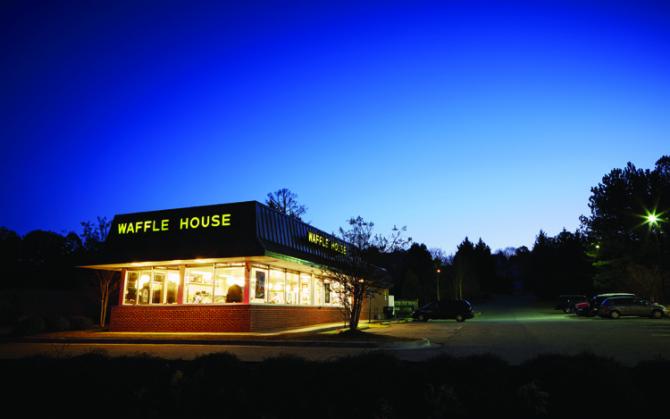
Snowmageddon. Icepocalypse. Cartastrophe. Whatever you call it, none of the executives gathered for a Waffle House senior management meeting in suburban Duluth, Ga., on Jan. 28, 2014, could have predicted the impact that a few inches of snow and ice would have upon greater Atlanta that day. Yet they were better prepared for the storm’s unexpected effects—including the epic gridlock that snarled the area’s roadways for days—than virtually everybody else.
“We’re all a bunch of weather junkies here,” says Will Mizell, Mgt 87, Waffle House vice president of people. “We have to be. It’s part of who we are as a company, and part of the areas of the country we serve. On that Tuesday morning, we knew there was a winter storm system moving in, and we were keeping a close eye on it. Still, what happened took us by surprise.”
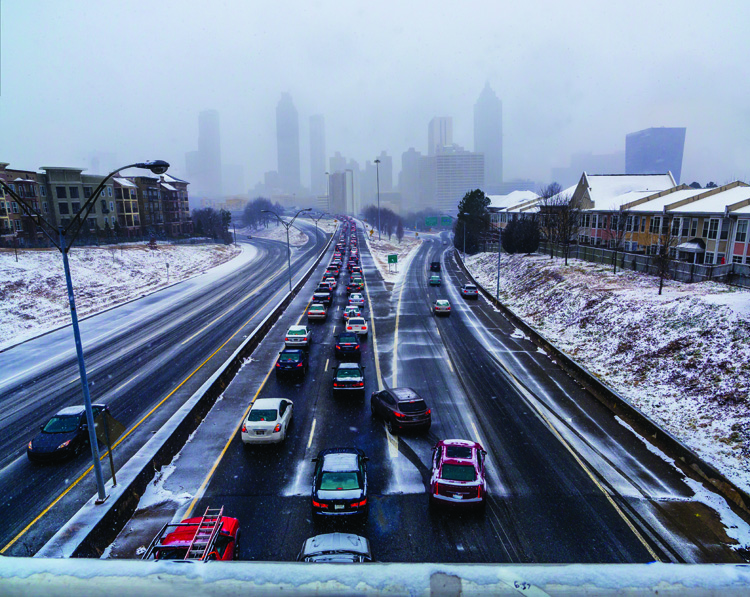
Atlanta Snowmageddon 2014
Most of us remember what happened hours later, even if we didn’t experience it first hand. Snow started falling just before lunchtime, some of it turning to ice and making driving conditions truly treacherous. Georgia Department of Transportation crews rushed to salt and clear the roads, but were too late. At around 1 p.m., businesses and school systems across the region decided to shut down and send everyone home. The mass exodus, mixed with the accumulating snow and ice, proved to be a recipe for disaster. Commuters and school buses hit the roads almost simultaneously, and thousands of people wound up stranded for the evening, miles away from home, cold and hungry.
One of the few businesses that didn’t close, of course, was Waffle House. “It’s a point of pride that we do so well to keep our restaurants open 24 hours a day, seven days a week, 365 days a year, in almost any situation,” says Waffle House President and CEO Walt Ehmer, IE 89. “Over the years, we’ve kept getting better and more efficient in our preparations. Part of it has been practice and repetition, learning as we go along, and part of it has been putting the right tools and technology to work for us as they became available. In any case, we had faced far worse weather events than this.”
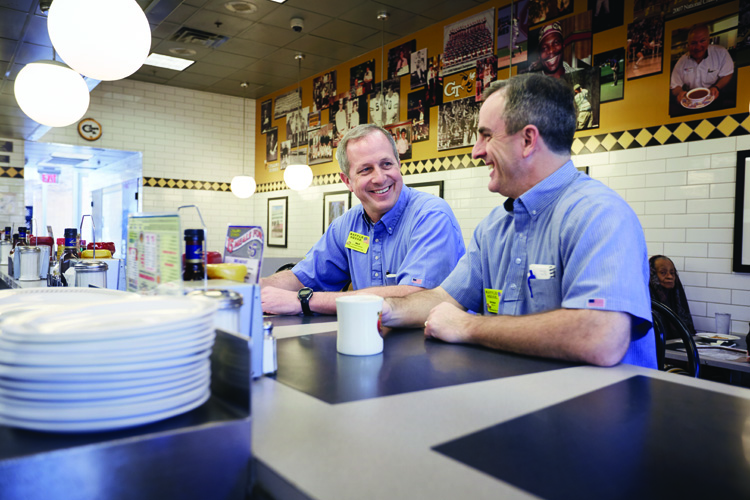
Waffle House CEO Will Ehmer (left) and Vice President of People Will Mizell.
There’s a popular urban legend that Waffle House doors have no locks—and with good reason. Since the day Joe Rogers Sr. and Tom Forkner opened that first restaurant in Avondale Estates, Ga., in 1955, operating 24/7 stood as one of Waffle House’s core tenets. “Joe Sr. always believed that if you want to be of full service to the people in your community, you have to be there for them—all of them—at all times,” Mizell says. “That includes those who work the late shift and those who need a warm meal or safe shelter during a crisis.”
Today, Waffle House Chairman Joe Rogers Jr., IM 68, continues his dad’s legacy of service by doing his best to keep the company’s “always open” vow a centerpiece of its business. But it wasn’t until Hurricane Hugo made landfall in South Carolina in 1989 that company executives began to consider approaching natural disasters in a carefully scripted, systematic way, Ehmer says. Hugo turned out to be, at the time, the costliest hurricane in U.S. history, and Hugo wound up causing considerable damage and distress to many communities that Waffle House served.
“Our restaurants and people made Herculean efforts to stay open for those affected by Hugo, but it wasn’t always an efficient process,” Ehmer says. “Sometimes it was like throwing chaos at chaos.” In an effort to minimize the chaos and maximize its effectiveness, the company literally drew up a playbook—one that has continuously evolved—to take on the worst Mother Nature could dish out.
“We simply didn’t have much exposure to large-scale storms and hurricanes before Hugo,” Ehmer says. As Waffle House grew and locations expanded across the Atlantic Coast, the South and the Midwest, so did its vulnerability to potential calamities of all sorts, be they hurricanes, tornadoes, ice storms, blizzards or floods. Today, the company operates 1,752 locations in 25 states, employing approximately 40,000 workers.
Ehmer remembers the first big weather event he encountered shortly after starting work at Waffle House. It was an honest-to-goodness blizzard—dubbed at the time as the “Storm of the Century”—that hit Atlanta in March 1993. “I was in purchasing at the time, and I had to work long hours on the logistics of getting food to our restaurants across the region,” he says. “The storm lasted days, most roads were closed and power outages were rampant, but we were able to get or keep most of our restaurants up and running.”
What struck a chord with Ehmer was just how much the community cared about what Waffle House did in the face of catastrophe. “As a new employee, it was truly inspirational to realize that our efforts really mattered to a lot of people,” he says. “The Atlanta Journal-Constitution even ran an ad thanking us, Georgia Power and Kroger for going above and beyond the call of duty for the area’s citizens.”
A little more than a dozen years later, Mother Nature finally unleashed her worst, as Hurricane Katrina devastated New Orleans and the Gulf Coast in August 2005. Katrina’s aftermath truly tested Waffle House’s mettle and mission. “We had to shut down 107 restaurants along the I-10 corridor from Florida to Louisiana,” Mizell says. “And we completely lost seven locations to the storm.”
The scope and visibility of Waffle House’s recovery efforts were unprecedented in the history of the company. However, the lessons learned and the readiness plans put into place since Hugo all paid off. The company got 75 percent of its affected restaurants back up and running within a few days.
“Katrina confirmed and emphasized our strengths and teamwork,” Ehmer says. “We fed a lot of hungry people who hadn’t had a hot meal in days. We knew we were making a difference on a large scale, and that knowledge made the hard work and long hours and money spent worth it.”
Keeping its restaurants open during a natural disaster does come at a sizeable cost for Waffle House. However, it’s a price worth paying, says Mizell. “We definitely lose money in the short term whenever a significant storm hits,” he says. “Others might sit back and collect business interruption insurance, but we don’t. In the end, our ‘always open’ commitment is a sound investment in our communities and our brand that pays us back many times over in terms of goodwill.”
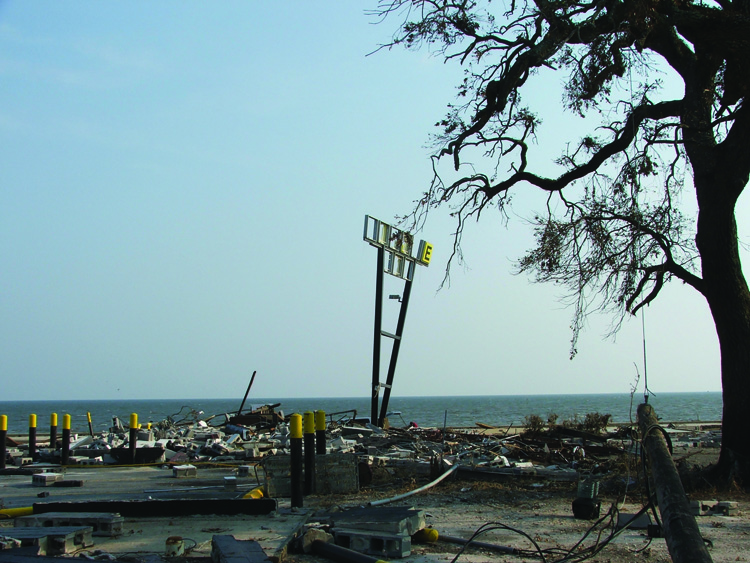
Waffle House lost seven of its restaurants to Hurricane Katrina. Yet, it had 75 percent of its affected locations back up and running within a few days.
“A lot of times storms are oversold, but we were ready to leap into action,” Ehmer says of Atlanta’s 2014 Snowmageddon. “As soon as we heard reports of what was happening across the area, we promptly ended our leadership meeting and sent out our managers and top executives to the restaurants to help.”
Like the military, Waffle House believes its “generals”—the senior leadership team—should be stationed on the front lines, where they can pitch in and lead by example. “We don’t expect our 40,000-plus associates to do anything that we wouldn’t do ourselves,” Ehmer says.
Ehmer credits Joe Rogers Jr. for establishing the company’s “show up” culture. “Joe sets the tone by showing up at our restaurants to work nights, weekends and holidays,” Ehmer says. “That culture carries over to our crisis response, too. Whenever our customers and employees need us, we ‘show up’ and get to work.”
Only Mizell stayed back at company headquarters in suburban Norcross, but it was so he could set up a command center to monitor weather and traffic conditions and serve as a centralized point of communications with restaurants in the region.
This storm was a rare and messy situation, Mizell says. “The worst of the traffic snarls hit right after the lunch shift and our restaurants were mostly manned with skeleton crews. Some employees had left to go home and got stuck on the way, while their replacements couldn’t get to work. Luckily there were no power outages at any of our locations.”
The first order of business that night was to make sure the restaurants were properly staffed. After all, if things were as bad as they looked, Waffle House would become a beacon of food, warmth and safety for stranded motorists. The solution that Mizell and the executive team agreed upon was to get as many company-owned and personal four-wheel-drive vehicles on the roads to transport employees to and from restaurants.
Ehmer himself had a 4×4, but as fate would have it, his son, Greg, had the vehicle with him at Georgia Tech, where he is a business student. So Ehmer hopped in his car and onto I-85, and hoped for the best. About a third of the way to Tech, however, he got stuck and almost had to hike his way on foot to the nearest refuge, which, of course, was a Waffle House.
“I eventually got to our nearest restaurant at Clairmont and I-85, but immediately dove into the tasks that were needed—bussing tables, washing tables, cooking,” Ehmer says. “It’s what we’re all expected—and trained—to do as Waffle House employees.”
He then met up with a division manager who had a 4×4, and they rode around to check in on other restaurants in the area until 5 a.m. “We were up all night,” he says. “Our stores were packed. Word quickly spread that we were one of the few businesses operating, and people sought us out, even if it was just a place to get warm. At least at one location, some customers even pitched in and helped us get food out of the kitchen and keep the restaurant clean.”
Finally, later in the morning Ehmer was able to take MARTA down to Tech and get his 4×4 so he could use it to shuttle employees, as well as food and supplies, to and from Waffle House locations. Scores of other executives and associates were doing the same thing.
Back at headquarters, Mizell kept tabs with restaurant managers and his fellow executives on the front lines. One of the ways Waffle House stays on the cutting edge of disaster response is that it employs a centralized software system where everyone logged in can see what the most immediate needs are across the system—whether it’s food, supplies, power or anything else. “In the past, we’d have to call or radio in one-on-one, and reporting of critical information was slow and sometimes inaccurate,” Mizell says.
After the storm, Mizell collaborated with U.S. Foods, Waffle House’s major food distribution partner, to make sure supplies got where they were needed. He also made sure nearby hotel rooms were secured so associates had a place to stay if they couldn’t get home. “Most locations were able to maintain full menus through the first day, but some had limited inventory and were forced to temporarily make do without certain items,” Ehmer says. “For example, restaurants that ran out of hamburger buns used Texas toast or regular bread instead. Our customers, thankfully, are very understanding when we have to improvise.”
Overall, setting up a command center with an operations expert like Mizell running the show has really helped Waffle House keep up with the speed and complexities of disaster response, Ehmer says. “Things can change so rapidly, it’s critical to be able to monitor situations from a bird’s-eye view,” he says.
So the question remains: Why does Waffle House, in particular, excel in responding to natural disasters and other emergencies better than virtually everybody else? Proper planning and the right tools and smart leadership certainly all play a role.
However, Ehmer says it primarily comes down to one thing: “We simply have more ‘want to’ than anyone else. We’ve built a reputation of standing strong in the face of adversity and we’re committed to maintaining it.”
Waffle House truly thrives on performing as a team under extreme circumstances. “We are blessed with a special group of employees that rally and come together when we’re needed,” Ehmer says. “And when we get through an event, we stand proud of our performance. We know we’ve made a difference in people’s lives when things were dark. We also know we’re not curing cancer; we’re not fighting wars. We may be just waffles and bacon and eggs, but a hot meal can be an oasis in the middle of a disaster.”
SCATTERED, COVERED AND SMOTHERED:
HOW WAFFLE HOUSE RESPONDS TO DISASTER
Waffle House’s reputation for disaster response and operational excellence is so strong—thanks to a core of Georgia Tech-trained engineers and business executives—that some pundits have publicly wondered if the nation might be better off having the company running the government. We all remember how slow the Federal Emergency Management Agency (FEMA) took to respond to Hurricane Katrina. (More on FEMA below.)
Here’s a look at the resources and processes that Waffle House deploys today to keep its restaurants open 24/7/365 in times of adversity:
- Consulting the disaster operations manual. “Everything starts with consistent risk management processes and making sure they’re all written down clearly and are easy to follow,” says Waffle House Vice President of People Will Mizell. “We constantly update it.”
- Sounding the all-hands-on-deck alert. “An important part of Waffle House culture is that senior management leads from the front lines, especially in times of crisis,” Mizell says. “All our executives have been trained to run a restaurant, and know how to cook and everything else.” In addition, the company mobilizes all its associates in an affected area to help. “This approach to teamwork really shines,” he says. The company makes sure its employees have a place to sleep if they’re stuck at a location by booking nearby hotel rooms.
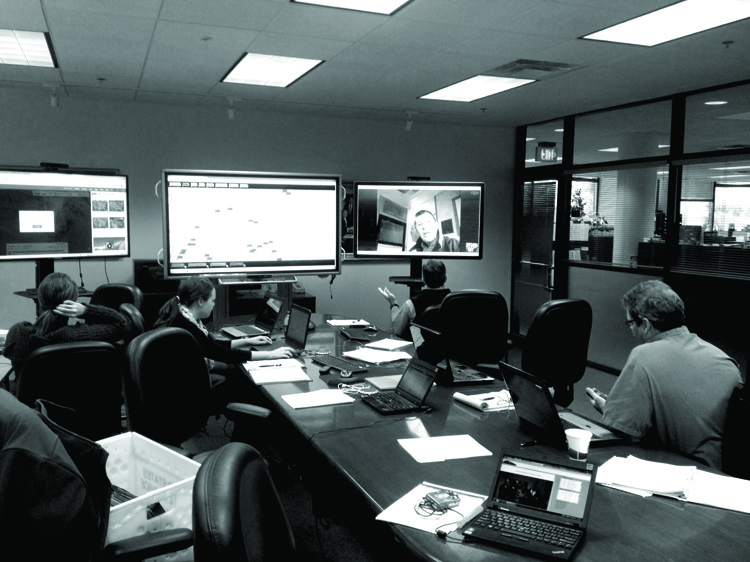
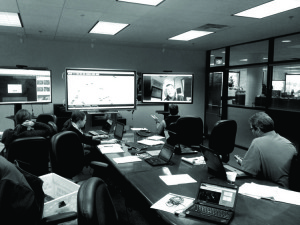 Setting up the command center. “At Waffle House HQ, we closely monitor traffic, road closings, weather updates and local news reports,” he says. “We’re also able to track our restaurants’ status in real time, as well as food, supplies, power generators and more.” During hurricanes, the company uses HURRTRAK software to follow the storm’s path and predict where the worst damage will be. The communications team has also found that social media, especially its Twitter account, is useful for letting everyone know which Waffle Houses are open for businesses.
- Sending out the command RV. “Often during a storm phone lines will be down, so we’ve equipped an RV with a satellite link, as well as with Wi-Fi capabilities, so we can keep communications open,” Mizell says. “We lovingly call it the EM-50, in homage to the movies Stripes. It also serves as a mobile field office and sometimes we use it as a PR vehicle, along with our separate Waffle House food truck.”
- Mobilizing the ‘Go Team.’ “We assemble our resources just outside affected areas in staging zones, ready to go in and help as soon as they can,” Mizell says. “Our construction teams will have building supplies and power generators at hand, and they’ll fix any damage and get power running if the electricity is down. We have a generator that’s so big we have to unload it from a truck with a crane.” Waffle House also deploys bladder trucks to keep the generators filled with gas, as well as reefer trucks to refrigerate food that would otherwise go rotten.
- Collaborating with local authorities. “Part of our success is our ability to partner with state patrols, the local police and emergency management staff, health inspectors and more,” Mizell says. “In fact, often times because of our strong reputation handling disasters, we’ll have an ‘all-access’ pass to hard-hit areas where roadblocks and curfews are set up to keep out most others.”
- Ensuring safety and security. “While the police can help, we have to make sure our restaurants and assets are protected from both hazardous situations and criminal activity,” he says.
- Communicating with vendors. “Luckily, our major distributor who handles everything but bread, produce and dairy is U.S. Foods, and they’re located just a mile away from Waffle House headquarters, which makes things easier,” Mizell says. “We have strong relationships with all our vendors, and they’re quick to jump in to help us keep our restaurants running when we sound the alarm.”
“Of course, every natural disaster is different, and sometimes we have to throw a little chaos at chaos until we understand a particular situation,” says Waffle House CEO Walt Ehmer. “Once the storm hits, our local teams mobilize and act as triage, assessing damage and status, and setting priorities. Everybody pulls together, and with these resources and plans in place, there are few catastrophes that we can’t make better.”
FEMA’S “WAFFLE HOUSE INDEX”
When it comes to understanding how badly a community has been hit by a natural disaster, the Federal Emergency Management Agency (FEMA) turns to Waffle House for cues. In fact, FEMA officially calls this the Waffle House Index.
- If the company’s restaurants are up and running in an affected region with little to no impact on service, then things probably aren’t too bad. That merits a green status on the index.
- However, if one or more locations can’t get full supplies and are serving a limited menu, FEMA knows it’s time to be concerned. Condition yellow.
- And if a Waffle House restaurant is damaged or without power and closed, then the local situation has truly turned serious. Red alert.
Because Waffle House weathers disasters so well, FEMA’s index seldom reaches red.
The Waffle House Index not only tells FEMA how soon a restaurant location may rebound, but also how the surrounding community is doing. The quicker that service businesses can rebound from storms, the sooner the community will move toward recovery. The Insurance Information Institute estimates that 25 percent of businesses that close following a natural disaster never reopen.



 Twitter
I am so proud to be a native-born Georgian, a Tech alum, and an IE. I happened to be in the Atlanta area (from my home in Florida) during the 2014 storm and was so impressed with the efforts made by so many in the community to help those who were stranded. Thank you, guys and gals, for all that you do to keep our communities cohesive and safe. You and Waffle House matter more than you know to alums all over the world! Harriet Jo Anne Freeman, IE, 1966.